
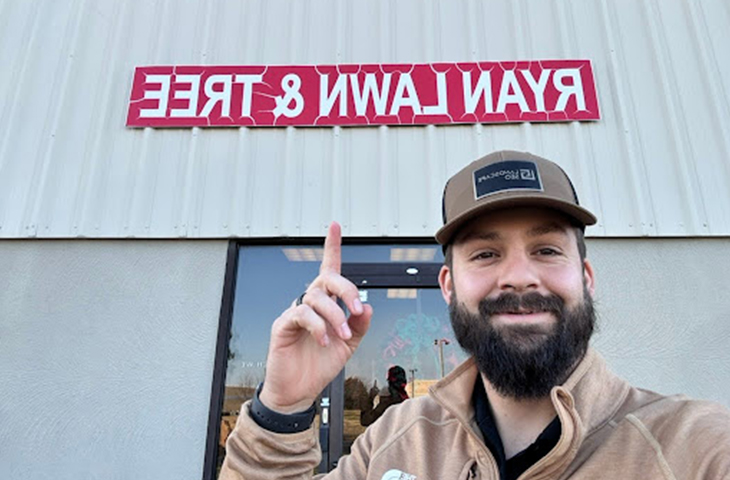
Hi everyone, I’m Luke Truetken. Recently, I had one of those rare, unfiltered conversations with Larry Ryan the founder of Ryan Lawn and Tree. We recorded a podcast episode in Broken Arrow, Oklahoma, at one of the many branches of Ryan’s Lawn and Tree. I walked away with a treasure trove of insights that have reshaped my thoughts about leadership, growth, and what it means to “work in your business.” Today, I’m excited to share one of the takeaways from that conversation. You’ve probably heard the standard “guru” advice: step away from the daily grind, focus on strategy, and work on your business. But Larry’s experiences reminded me of a much more valuable lesson: get in the trenches.
Larry stressed the irreplaceability of being out in the field, getting your hands dirty, and seeing firsthand what’s happening. When immersed in the day-to-day, you discover nuances in your operation that no office meeting reveals. It’s about knowing every blade of grass (and every client’s needs) so you can make informed decisions that drive long-term success.
Most of the so-called gurus will tell you to detach from the operational side of your business to focus solely on big-picture strategy. But here’s the thing: if you don’t understand the intricacies of your business from the ground up, how can you truly help your team when they’re facing challenges? Imagine one of your crew members comes back saying, “I wasn’t able to finish my route today,” or “I couldn’t complete this task to the high standard we set.” You might not know how to respond if you’ve never been in their shoes. However, if you’ve been in the field yourself, you can confidently say, “I know you could have done it faster and better because I’ve been right there with you, tackling those same challenges.”
Being in the field isn’t about micromanaging; it’s about genuinely understanding what it takes to do the job well. This firsthand experience allows you to offer practical, specific feedback and coaching that resonates. You’re not just enforcing policies from an office, you’re relating to the day-to-day realities of your team. That insight builds trust and empowers your employees to excel because they know you’ve earned credibility through hard work, not just theoretical expertise.
Context Matters: When “Work On Your Business” Makes Sense
It’s essential to understand the context behind the often repeated phrase, “Work on your business, not in your business.” This advice is usually given to already huge companies, where the owner can become a bottleneck if they try to micromanage every detail. In such cases, stepping back to focus on strategy and delegating daily operations is essential to prevent the owner from being overwhelmed.
However, for most companies (especially when you’re still growing) it’s critical to be deeply involved in the day-to-day tasks. Efficiency and a thorough understanding of every operational nuance are how you help your team grow and scale into leadership roles. As a blanket statement, “Work on your business, not in your business” is the wrong advice for most small or growing companies.
Larry drove this point home during our conversation. Reflecting on a discussion with a young business owner who was struggling, Larry recalled:
“What would you tell that person now, knowing what you know? I talked with a struggling young man from B-town a year ago. He belonged to one of those groups where they gave you counsel and was told, ‘Step back and work on your business, not in it.’ But he was going broke. The amount of money he was losing every year was about the same as his salary and the other office person’s salary. They both should have been in the field. I said, ‘You can work on your business while doing the work. The beautiful thing about fertilizing a yard or mowing or pruning trees is: what do you think about when doing that work? You can think about the party Saturday night, or I always thought about the next hire I was working on, or the newsletter I was writing for customers, or how I was going to recruit that great guy from Oklahoma State to join us.’”
He emphasized that telling small business owners to leave field work is poor advice. Larry stressed that he worked in the field daily until they hit about $4 million in revenue. He even admitted he should have stayed there longer because those experiences—interviewing people at night, riding along with his team on Saturdays, and sacrificing personal time—helped build a strong foundation for the business.
This isn’t just about clocking in extra hours; it’s about cultivating a leadership style that combines strategic vision with practical, hands-on know how. When you’ve been in the field, you’re more empathetic to your team’s struggles and better equipped to guide them toward success. You understand what it takes to get the job done, and that knowledge allows you to work on your business without losing touch with the core operations.
The Balanced Approach: Working On and In Your Business
The takeaway here is simple: you can—and should—work on your business while working in your industry. Especially when you’re small or growing, don’t feel pressured to abandon the field entirely in favor of a high-level strategy. The two are not mutually exclusive. Instead, let your daily experiences inform your big-picture strategy.
You maintain credibility, understand your team’s challenges, and build a strong, efficient operation by being in the trenches. This hands-on approach ensures that when you eventually focus more on strategy, you do so from a position of genuine insight and deep operational knowledge. A balanced leadership style fosters growth, accountability, and real-world problem solving.
Remember: don’t let the lofty advice of the gurus distract you from the essential work of knowing your business inside and out. For most of us, getting in the trenches is the most effective way to build a strong foundation for lasting success.
What are your thoughts? Have you found that working in your business has given you insights you’d miss from afar? Let me know in the comments below.
